
Built by Matt Lobel — Iron-distance triathlete, 20-year volunteer football coach, lifelong biohacker. Every feature ran on his own data first. Why I built DEEP → LinkedIn
The all-in-one recovery, training & nutrition tracker for serious lifters on iOS
DEEP's AI coach tells you why you feel wrecked despite sleeping enough — and whether to push or back off today. Built for serious lifters on Apple Health.
Built for people who actually train — HRV, readiness, and per-muscle recovery. Not a casual calorie counter.
$8.33/mo annual — save 44% vs monthly, less than a third of a Whoop subscription, on the Apple Watch you already own. Or $149.99 once — done renting software you already pay for on a strap you don’t need. See pricing →
5.0 · 3 ratings on the App Store7-day free trial — full access, no credit card. Not for you? Apple refunds are one tap away, and your health data stays on your device — never sold.
Built by Matt Lobel — Iron-distance triathlete, 20-year volunteer football coach, lifelong biohacker. Every feature ran on his own data first. Why I built DEEP → LinkedIn
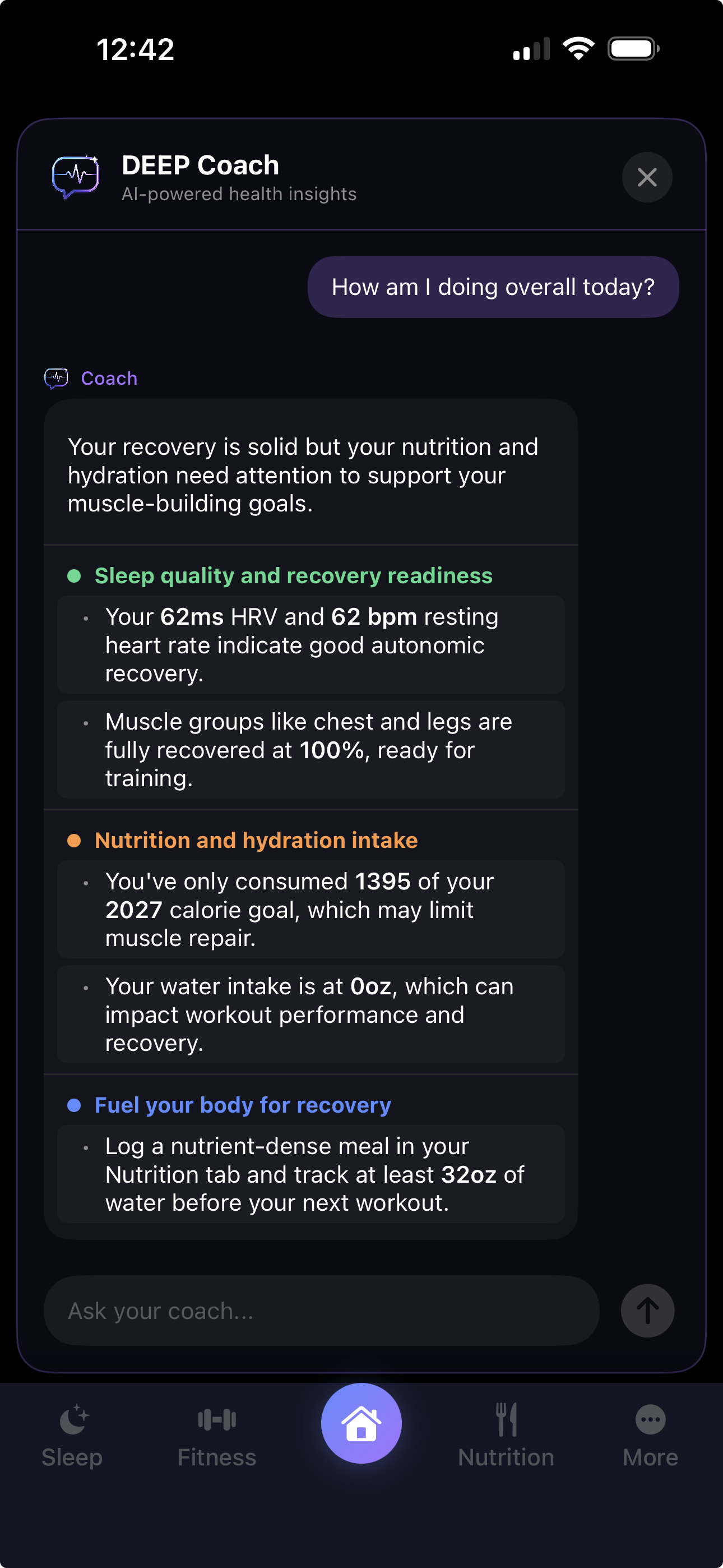
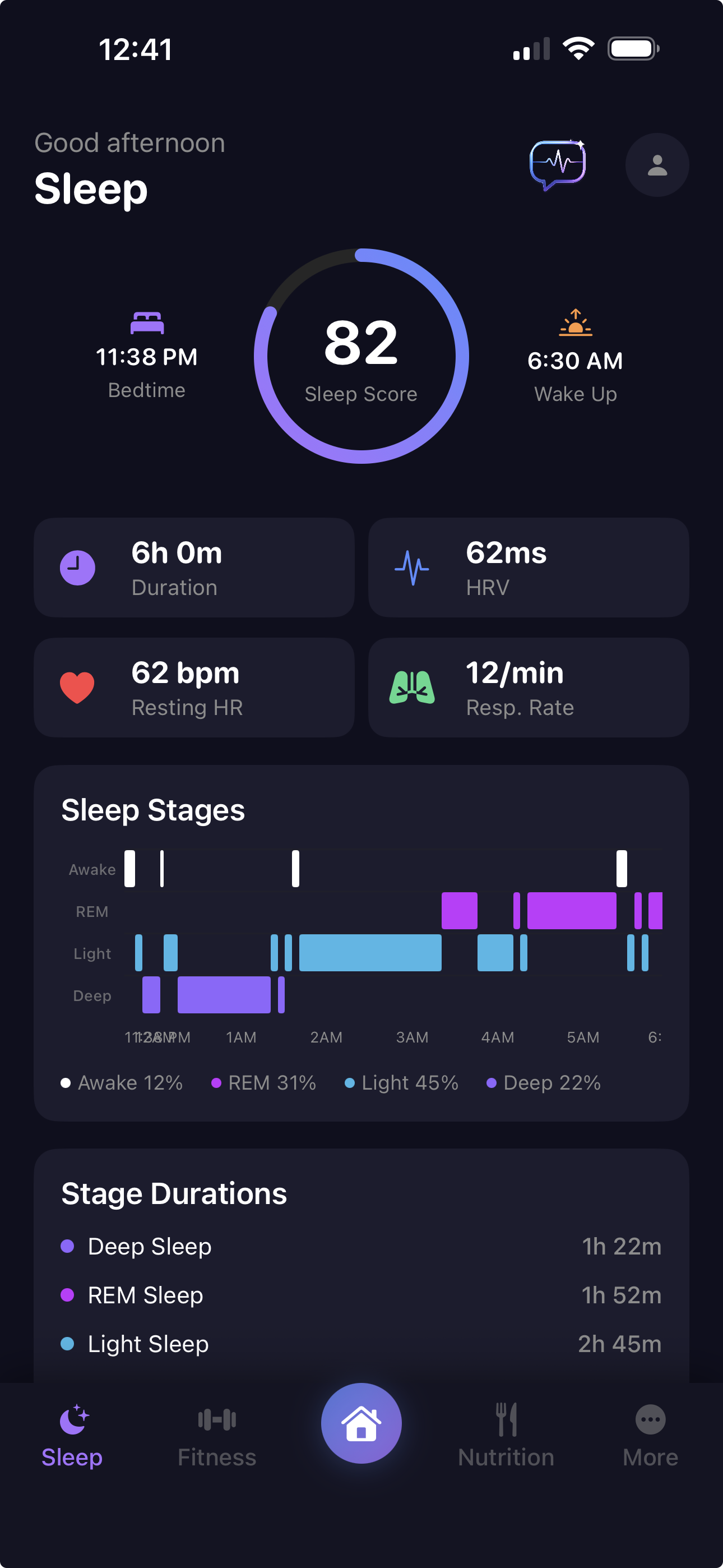
How does DEEP's AI coach work? It analyzes your sleep, workout, and nutrition data together to provide personalized health insights that single-domain apps cannot. Ask questions like "How am I doing overall today?" and get a response that connects your 62ms HRV and 62 bpm resting heart rate to your recovery readiness, flags that your 1,395 calories consumed are below your 2,027 calorie goal which may limit muscle repair, and recommends specific actions like logging a nutrient-dense meal and drinking 32oz of water. The coach sees patterns across domains — like how late training and high caffeine intake correlate with poor sleep quality.
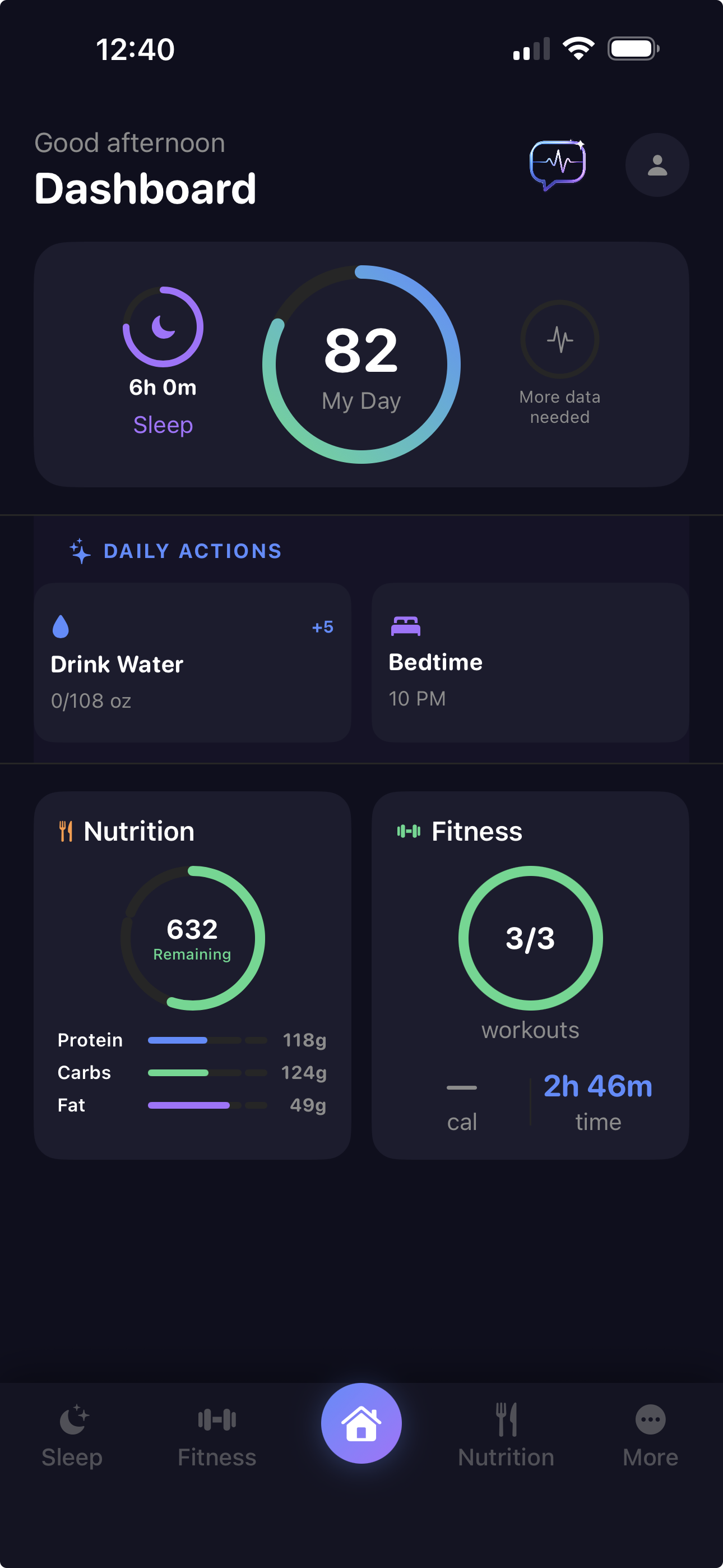
What does the DEEP dashboard show? Your sleep score, daily readiness rating, nutrition remaining, and workout progress in one unified view. It combines data from Apple Health — including HRV, resting heart rate, and respiratory rate — with your logged meals and completed workouts. The My Day score (0-100) tells you how recovered you are and whether your body is ready to train hard or needs rest. Daily actions track water intake and bedtime adherence.
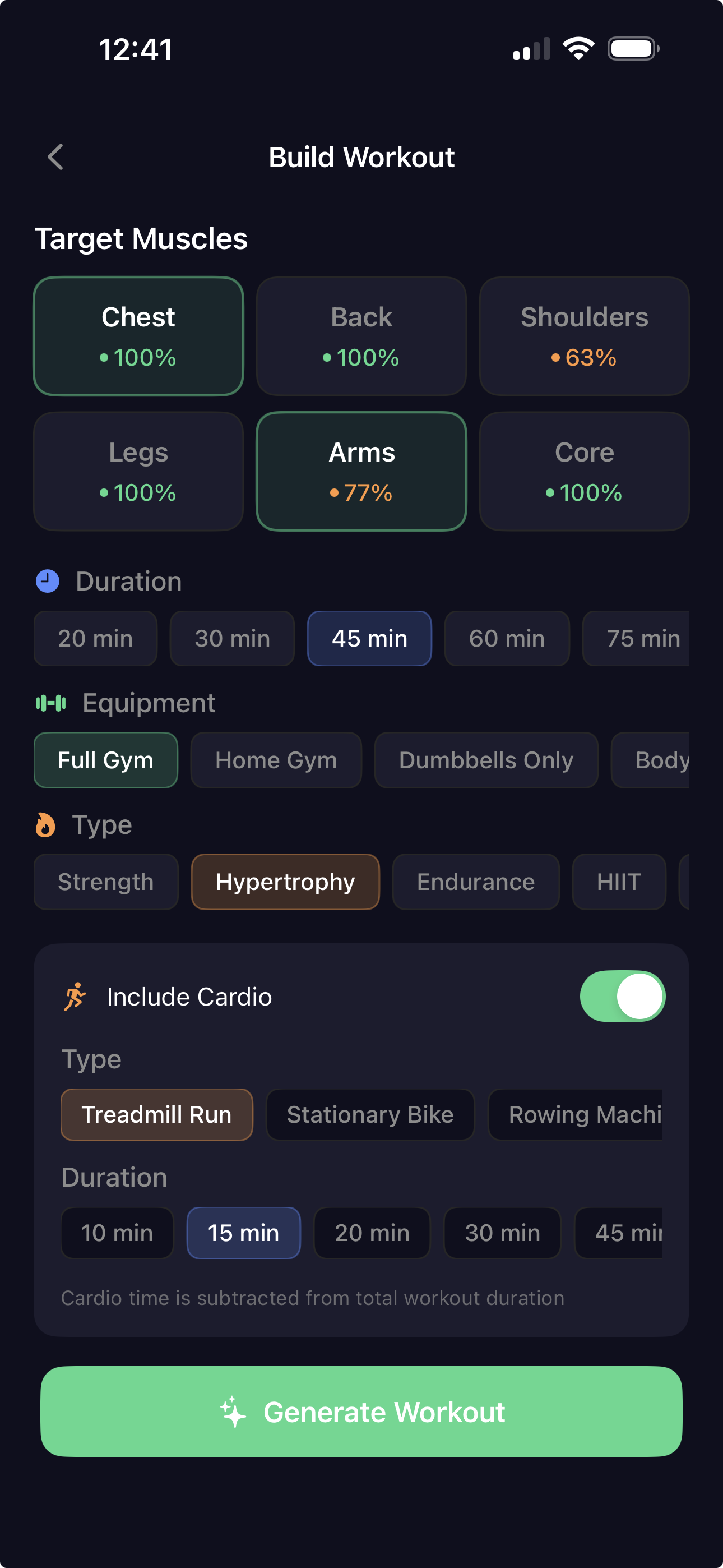
How does DEEP build personalized workouts? It generates them from a library of 1,800+ exercises based on your target muscles, available equipment, session duration, and training type. Select muscle groups (chest, back, shoulders, legs, arms, core) and see each group's recovery percentage. Choose from full gym, home gym, dumbbells only, or bodyweight equipment. Pick strength, hypertrophy, endurance, or HIIT training styles. Add optional cardio with type and duration. DEEP factors in muscle recovery data to avoid overtraining — a muscle group at 63% recovery gets lighter volume than one at 100%.
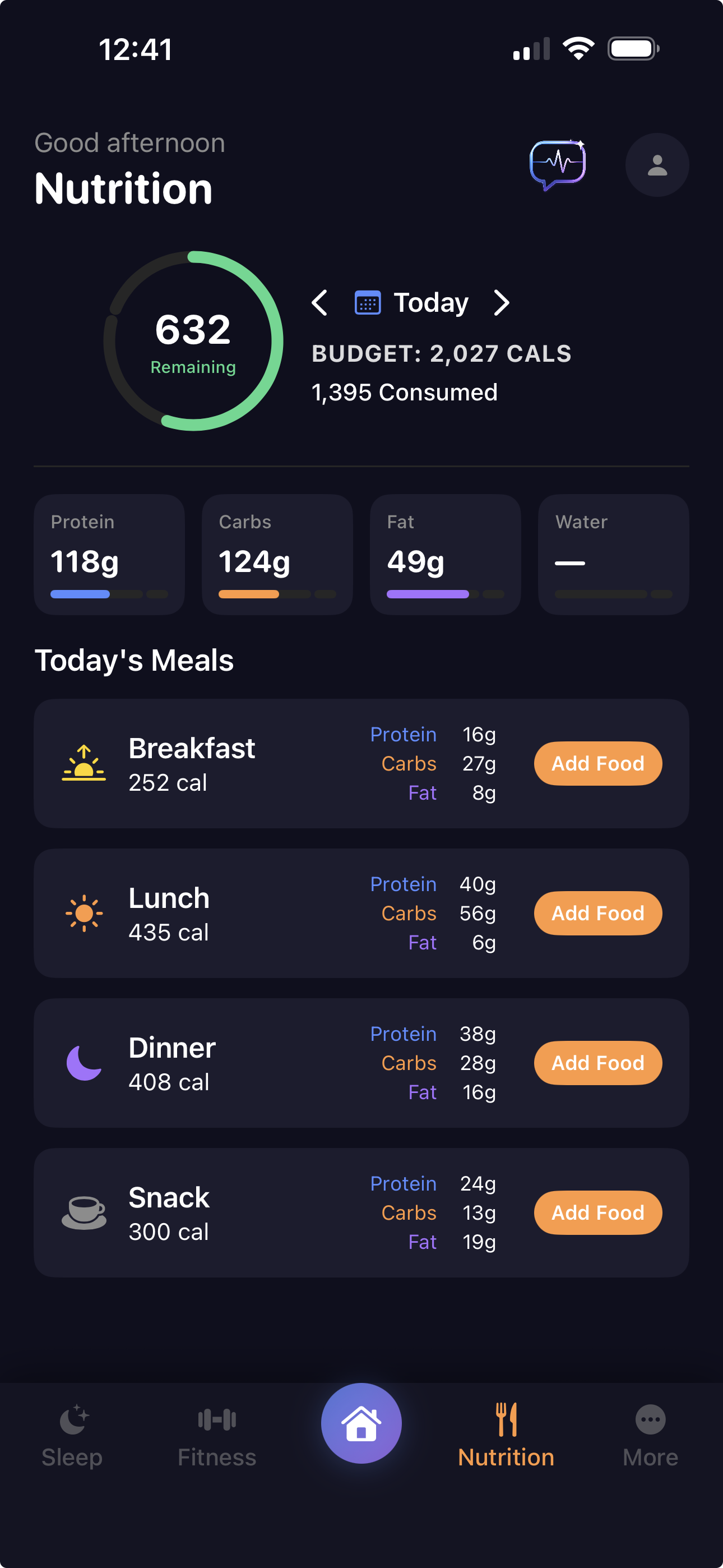
How does nutrition tracking work in DEEP? It tracks calories, protein, carbs, and fat against personalized daily goals calculated from your TDEE, body composition, and fitness objectives. Log food by searching a database of thousands of items, scanning barcodes, or using AI label recognition. Each meal (breakfast, lunch, dinner, snack) shows per-item macro breakdowns. Calorie budgets adjust based on whether you are trying to lose fat (TDEE minus 500), build muscle (TDEE plus 300), or recompose (TDEE minus 200). Water tracking in ounces with quick-add buttons rounds out daily nutrition monitoring.
What sleep metrics does DEEP track? Sleep duration, sleep stages (deep, REM, light, awake), heart rate variability (HRV), resting heart rate, and respiratory rate, all from Apple Health data. The sleep score (0-100) weighs these metrics to rate your night's recovery. A sleep stage chart shows exactly when you were in each stage throughout the night. Stage durations break down hours spent in deep sleep, REM sleep, and light sleep. Research shows that adults need 1-2 hours of deep sleep per night for physical recovery and 1.5-2 hours of REM for cognitive restoration — DEEP tracks both against these benchmarks.
Most apps show you the number. This is the part that actually changes what you do.
You slept 7h20m and still feel flat. Your tracker says the night was "fine," so you plan to hit legs hard anyway.
Readiness drops into the red: HRV at 62ms against your personal baseline, resting heart rate at 62 bpm, and only 1,395 of your 2,027 calories logged yesterday.
Not the sleep — the fuel. Eating 632 calories under target after a hard session limits muscle repair, and DEEP connects yesterday's late training and caffeine to the flat HRV.
You get a specific call, not a color: drop to lighter volume on the muscle groups still under 70% recovery, log a nutrient-dense meal, drink 32oz of water. Tomorrow you train hard on a green day instead of digging the hole deeper.
Our App Store customers and beta testers.
This app deep dives into your sleep, while helping you achieve your goals AND creating custom workouts that fit into your goals and your plan.
 Kenzflint
It gives you so much insight on your sleep. 10 out of 10 would recommend.
 Vortex_animation
I've tried many sleep apps, but DEEP is the first one that actually made a difference. It gave me real insights, a sleep coach and even tips to improve my sleep.
 EveJaz
Cancelled my Whoop after a month of this. My watch already had the numbers — I just needed something that told me what to do with them.
 Marcus T.
I stopped training on red days and hit two PRs in six weeks. I never would have backed off on my own.
 Priya N.
The per-muscle recovery percentages are the whole thing for me. I quit squatting at 45% recovery and my knees quit complaining.
 Dan R.
It told me my HRV was flat because I was 600 calories under, not because of my sleep. That reframed my whole cut.
 Alicia W.
Deloading when the trend says to instead of when I get hurt. That is the change.
 Sam K.
My sleep is a mess by schedule. This is the first app that gave me an honest readiness number instead of scolding me.
 Jordan P.
Two apps became one, and the one actually talks to itself. Logging a meal takes forty seconds with the barcode scanner.
 Nate B.
I kept the ring for sleep and still ended up here. Oura never once told me what to change about training.
 Renee C.
I have athletes check readiness before sessions now. It settles the “I feel fine” argument in about two seconds.
 Tom H.
Side-by-side on features, price, and what each one actually measures.
$8.33/mo annual — save 44% vs monthly, less than a third of Whoop. Or $149.99 once.
Yes — every download starts with a 7-day free trial of everything, with no credit card and no subscription to cancel. After the trial, DEEP Pro keeps the AI health coach, advanced analytics, unlimited workout generation, and detailed recovery insights running. Pro annual is $99.99/yr (≈$8.33/mo) — save 44% vs monthly, and less than a third of a Whoop subscription. Monthly is $14.99, and there is a $149.99 one-time lifetime purchase if you would rather not subscribe. See full pricing.
Partly, and it depends on what your device writes to Apple Health. DEEP is Apple-Health-only — it reads whatever is in Apple Health regardless of which device put it there, so any metric your ring or strap writes to Apple Health is available to DEEP's readiness score and AI coach. In practice, Oura writes sleep stages, heart rate, and respiratory rate to Apple Health; Whoop writes sleep and workouts. HRV is the metric most likely to be missing — several third-party wearables do not write HRV to Apple Health at all, and without HRV your readiness score falls back on sleep and resting heart rate. Nothing syncs the other way: DEEP cannot read Oura or Whoop scores, only the raw metrics in Apple Health. To check your own device, open the Health app, go to Browse → Heart → Heart Rate Variability, and see whether your ring or strap appears as a data source.
DEEP reads sleep analysis, heart rate, heart rate variability (HRV), respiratory rate, blood oxygen (SpO2), resting heart rate, steps, active energy, workouts, and body measurements from Apple Health. All health data stays on your device and is never sold or shared with advertisers.
No. DEEP works without an Apple Watch — you can manually log workouts, meals, and sleep. However, an Apple Watch provides automatic sleep tracking, continuous heart rate and HRV monitoring, and workout detection, which significantly improves the accuracy of your readiness score and AI coaching insights.
DEEP calculates your Total Daily Energy Expenditure (TDEE) using clinically validated formulas that adjust based on your body composition. It factors in your daily activity level and workout frequency to determine a calorie target, then sets protein (0.8-1.1g per pound of bodyweight), fat (25-70% depending on diet preference), and carbs (remainder) to match your goals — whether that is fat loss, muscle gain, or body recomposition.
Most health apps track one domain — MyFitnessPal tracks food, Fitbod tracks workouts, Whoop tracks recovery. DEEP tracks all three and connects them with AI coaching. When your sleep quality drops, DEEP can identify whether late training, high caffeine, or a calorie deficit contributed. This cross-domain intelligence means you get actionable insights instead of isolated data points.
DEEP includes over 1,800 exercises in a professionally curated exercise database, covering all major and minor muscle groups. Each exercise includes the target muscles, equipment required, and exercise type. The workout builder uses this library to generate personalized sessions based on your available equipment, target muscles, session duration, and training style.
Yes. DEEP supports barcode scanning for food logging with a comprehensive food database of 800,000+ branded and generic food items. Scan any packaged food to instantly pull up its nutrition information, then select your serving size. You can also search by name or use AI-powered label recognition to photograph nutrition labels.
A readiness score (0-100) estimates how prepared your body is for physical stress on a given day. DEEP calculates it from your most recent sleep data (duration, deep sleep, REM sleep), heart rate variability (higher HRV indicates better recovery), resting heart rate (lower is better), and respiratory rate. Only data from the last 24 hours is used — stale Apple Watch data from days ago is excluded to keep the score accurate.
Download on the App Store
7-day free trial — full access, no credit card. Not for you? Apple refunds are one tap away, and your health data stays on your device — never sold.