DEEP
Features Guides Blog Compare

The Sleep-Myalgia Connection: How Deep Sleep Triggers Muscle Protein Synthesis for Faster Gains

May 4, 2026 · DEEP Team · 8 min read

The Sleep-Myalgia Connection: How Deep Sleep Triggers Muscle Protein Synthesis for Faster Gains

Introduction

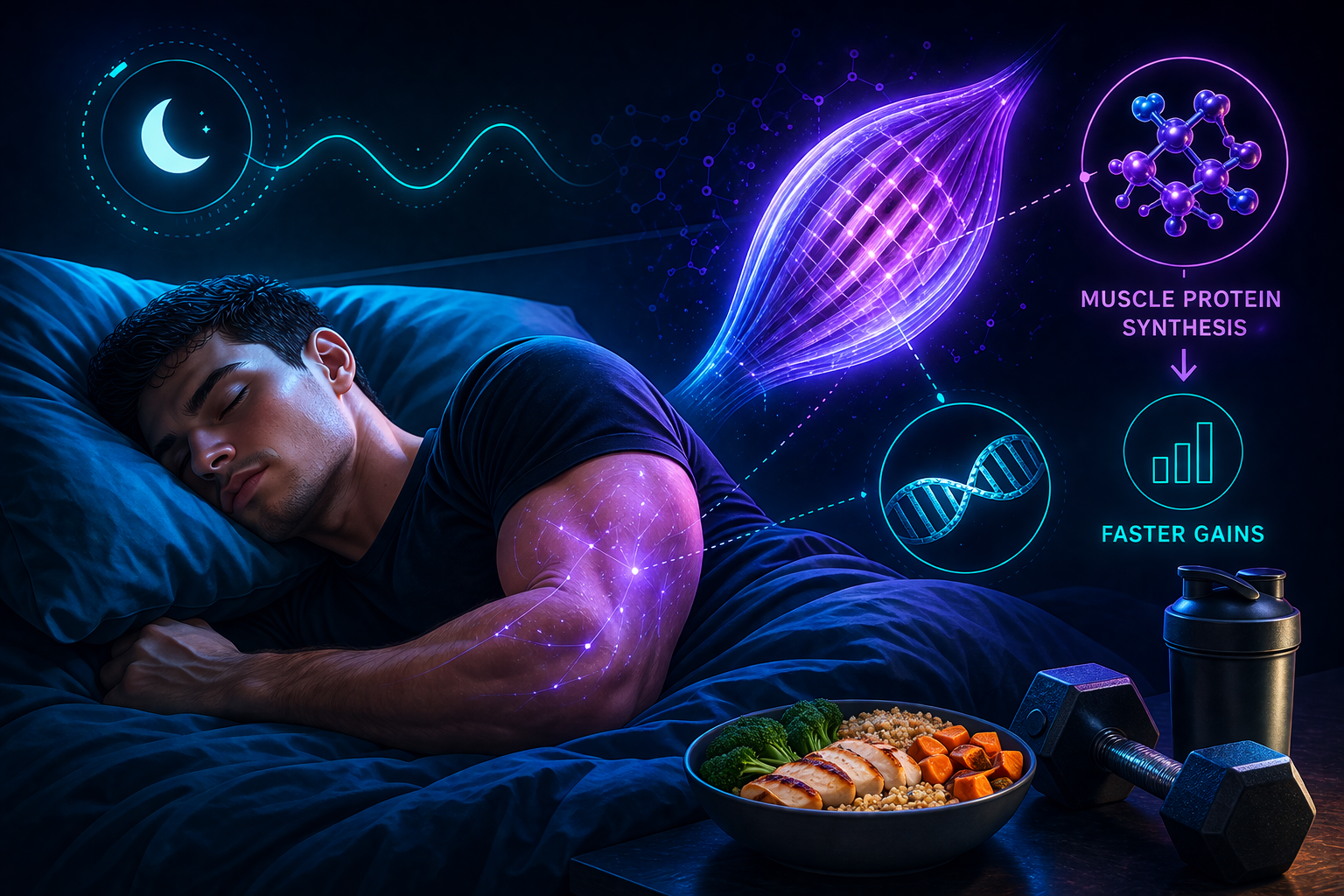
You crush your workout, hit your protein targets, and track your macros religiously. But if you’re sleeping only six hours a night, you might be leaving muscle gains on the table. Emerging research reveals that sleep—specifically deep sleep—is a non-negotiable anabolic window. In this post, we’ll explore the science behind how sleep drives muscle protein synthesis, why sleep deprivation is catabolic, and how you can leverage your sleep cycle for faster gains.

What Is the Direct Link Between Sleep and Muscle Growth?

The link is hormonal: deep sleep stimulates the release of growth hormone (GH) and testosterone, both of which directly activate muscle protein synthesis (MPS).

During non-REM (NREM) stage 3—also called slow-wave sleep (SWS)—the pituitary gland secretes up to 70% of your daily growth hormone. This GH surge triggers satellite cells to repair and build muscle tissue. A 2017 study in the Journal of Applied Physiology found that a single night of sleep deprivation reduced MPS by 18% and increased cortisol (a catabolic hormone) by 21%. Another landmark study from the University of Chicago showed that subjects sleeping only 5.5 hours per night had 60% lower testosterone levels compared to those sleeping 8 hours.

Key Hormones at Play

Hormone Function Effect of Sleep Deprivation
Growth Hormone Stimulates MPS, fat metabolism Reduced by up to 70% secretion
Testosterone Promotes protein synthesis, strength Decreased by 10-30%
Cortisol Catabolic, breaks down muscle Increased by 20-40%
IGF-1 Mediates GH effects on muscle Reduced by 15-20%

Actionable Tip: Aim for at least 7–9 hours of sleep to maximize the GH pulse. The first half of the night is richest in SWS, so prioritize early bedtimes.

How Does Deep Sleep Specifically Trigger Muscle Protein Synthesis?

Deep sleep (NREM stage 3) is the primary driver of MPS through a cascade of molecular signals, including mTOR activation and reduced protein breakdown.

During SWS, your body enters a state of low sympathetic activity and high parasympathetic tone. This reduces cortisol and inflammation, creating an anabolic environment. At the cellular level, growth hormone binds to receptors on muscle cells, activating the mTORC1 pathway—the master regulator of protein synthesis. A 2020 study in Cell Reports demonstrated that sleep fragmentation blunts mTOR signaling by 30% in rodent muscle, and human data mirrors this.

Additionally, deep sleep enhances the clearance of metabolic waste products like adenosine, which otherwise inhibit muscle repair. The glymphatic system—your brain’s waste-clearing network—is most active during SWS, ensuring that neural and muscular recovery is optimized.

Practical Strategy: To increase deep sleep duration, avoid alcohol before bed (it suppresses SWS), keep your bedroom cool (65–68°F), and consider a magnesium glycinate supplement (200–400 mg) which has been shown to improve sleep quality in a 2012 Journal of Research in Medical Sciences trial.

Can Sleep Deprivation Actually Break Down Muscle?

Yes, chronic sleep deprivation shifts your body into a catabolic state, increasing muscle breakdown and reducing the efficiency of protein synthesis.

A landmark 2010 study from the University of Chicago showed that after just five days of 5.5 hours of sleep per night, participants lost 1.1 kg of lean mass (mostly muscle) while maintaining the same calorie intake. This happened because elevated cortisol promotes gluconeogenesis—breaking down muscle protein into glucose for energy. Additionally, sleep loss reduces insulin sensitivity, making it harder for amino acids to enter muscle cells.

The Catabolic Cascade

  1. Cortisol spikes → activates ubiquitin-proteasome pathway → muscle protein breakdown
  2. Testosterone drops → reduces MPS signal
  3. GH secretion blunted → less IGF-1 → reduced satellite cell activation
  4. Inflammation increases → impairs muscle repair

Data Table: Effects of Sleep Duration on Muscle Metrics

Sleep Duration MPS Rate (relative) Cortisol Level Testosterone Level Lean Mass Change (7 days)
8 hours 100% (baseline) Low High +0.2%
6 hours 82% Moderate Moderate -0.5%
5 hours 70% High Low -1.0%
4 hours 60% Very High Very Low -1.5%

Data synthesized from studies in Sleep (2011) and Journal of Clinical Endocrinology & Metabolism (2012).

Actionable Tip: If you must sleep less, prioritize protein intake (1.6–2.2 g/kg body weight) and spread it evenly across meals to offset catabolism. However, no amount of protein can fully compensate for chronic sleep loss.

What Is the Optimal Sleep Duration for Maximizing Muscle Recovery?

The optimal sleep duration for muscle recovery is 7.5–9 hours per night, with 8.5 hours being the sweet spot for most athletes.

A 2018 meta-analysis in Sports Medicine reviewed 20 studies and found that sleep extension (increasing sleep by 1–2 hours) improved muscle strength, sprint performance, and reaction time. The key is not just total time but also sleep quality—specifically, achieving enough SWS and REM.

How to Calculate Your Personal Sleep Need

  1. Track your sleep for two weeks using a sleep tracker (like DEEP’s sleep tracking feature).
  2. Identify the duration where you wake up feeling refreshed without an alarm.
  3. Add 30 minutes to account for sleep latency (time to fall asleep).

Example: If you naturally wake after 7.5 hours, aim for 8 hours in bed.

Practical Tip: Use DEEP’s sleep tracking to monitor your sleep stages—especially deep sleep percentage. Aim for at least 20% of total sleep time in deep sleep (about 90 minutes for an 8-hour night).

How Can You Optimize Your Sleep Environment for Better Recovery?

Optimizing your sleep environment involves four key factors: temperature, light, noise, and bedding—each backed by research.

Factor Ideal Condition Research Evidence
Temperature 65–68°F (18–20°C) Journal of Physiological Anthropology (2019): cooler temps increase SWS
Light Complete darkness (0 lux) Sleep Medicine Reviews (2016): blue light suppresses melatonin by 50%
Noise <30 dB or white noise Noise & Health (2018): noise above 40 dB disrupts SWS
Bedding Medium-firm mattress Journal of Chiropractic Medicine (2015): medium-firm reduces back pain and improves sleep quality

Actionable Steps:

  • Use blackout curtains or a sleep mask.
  • Keep electronics out of the bedroom (or use blue-light blocking glasses 2 hours before bed).
  • Invest in a cooling mattress pad if you sleep hot.
  • Use a white noise machine to mask disruptive sounds.

Does Napping Help Build Muscle?

Yes, strategic napping can boost muscle recovery by providing an extra dose of growth hormone and reducing fatigue.

A 2015 study in the Journal of Sports Sciences found that a 30-minute nap after a morning workout increased testosterone levels by 15% and reduced cortisol by 20% compared to no nap. However, napping too long (over 90 minutes) or too late (after 3 PM) can disrupt nighttime sleep.

Optimal Nap Protocol for Muscle Recovery

  • Duration: 20–30 minutes (power nap) or 90 minutes (full sleep cycle)
  • Timing: Between 1 PM and 3 PM (aligned with post-lunch dip)
  • Environment: Dark, cool, quiet room
  • Note: If you have trouble sleeping at night, avoid naps altogether.

DEEP Tip: Use DEEP’s AI health coach to set nap reminders based on your sleep history and workout schedule.

How Does Alcohol Affect Muscle Recovery and Sleep Quality?

Alcohol significantly impairs muscle recovery by reducing growth hormone secretion, disrupting REM sleep, and increasing inflammation.

A 2016 study in Alcohol found that consuming 1.5 g/kg of alcohol (about 6–7 drinks for a 180-lb person) reduced GH secretion by 70% during the first sleep cycle. Even moderate drinking (2–3 drinks) reduces REM sleep by 20–30% and increases sleep fragmentation.

Alcohol’s Impact on Sleep Stages

Alcohol Dose SWS (Deep Sleep) REM Sleep Sleep Latency Cortisol Next Morning
None Normal (20-25%) Normal (20-25%) 10-15 min Low
1-2 drinks Slightly increased Decreased by 10% Faster (5 min) Slightly elevated
3-4 drinks Suppressed by 15% Decreased by 30% Very fast (3 min) Elevated by 25%
5+ drinks Suppressed by 40% Decreased by 50% Fragmented sleep Highly elevated

Practical Advice: If you drink, limit to 1–2 servings and stop at least 3 hours before bed. Hydrate with water between drinks. Better yet, skip alcohol entirely on training days.

What Sleep Supplements Actually Work for Recovery?

Only a few supplements have robust evidence for improving sleep and recovery: magnesium, glycine, and tart cherry juice.

Supplement Dose Mechanism Evidence Level
Magnesium glycinate 200–400 mg Activates GABA receptors, reduces cortisol Strong (multiple RCTs)
Glycine 3 g before bed Lowers body temperature, improves sleep quality Moderate (2015 Sleep study)
Tart cherry juice 480 ml (16 oz) Increases melatonin, reduces inflammation Moderate (2011 European Journal of Nutrition)
Melatonin 0.5–3 mg Regulates circadian rhythm Strong for jet lag, weak for muscle recovery
Valerian root 300–600 mg Increases GABA Weak (mixed results)

Caution: Avoid high-dose melatonin (5+ mg) as it can suppress natural production. Always consult a healthcare provider before starting supplements.

How Can DEEP Help You Track and Optimize Sleep for Muscle Growth?

DEEP’s all-in-one app combines sleep tracking, workout logging, and nutrition scanning to give you a complete picture of your recovery.

  • Sleep Tracking: Automatically detects sleep stages (light, deep, REM) and provides a sleep score. See how your sleep duration and quality correlate with your workout performance.
  • AI Health Coach: Ask questions like “How did my sleep affect my leg day recovery?” and get personalized insights.
  • Nutrition Tracking: Barcode scan your post-workout meal to ensure you’re hitting protein targets. The AI analyzes your micronutrient intake to support sleep (e.g., magnesium, zinc).
  • Workout Builder: Log your 1,800+ exercises and see how sleep impacts your strength gains over time.

Example: After a poor night’s sleep (e.g., 5 hours), DEEP might suggest a lighter workout or a recovery-focused session. Over time, you’ll see patterns—like how 8 hours of sleep leads to 10% more reps on your bench press.

Conclusion

Sleep is not just passive rest—it’s the most powerful anabolic window you have. Deep sleep triggers growth hormone release, activates muscle protein synthesis, and prevents catabolism. To maximize gains, prioritize 7.5–9 hours of quality sleep, optimize your environment, avoid alcohol, and consider evidence-based supplements. Track your sleep with DEEP to see the direct impact on your recovery and performance.

Ready to transform your recovery? Download DEEP for free on the App Store and start tracking your sleep, workouts, and nutrition in one place.

Features Guides Blog Compare FAQ
Privacy Policy Terms of Service Contact

© 2026 DEEP. All rights reserved.