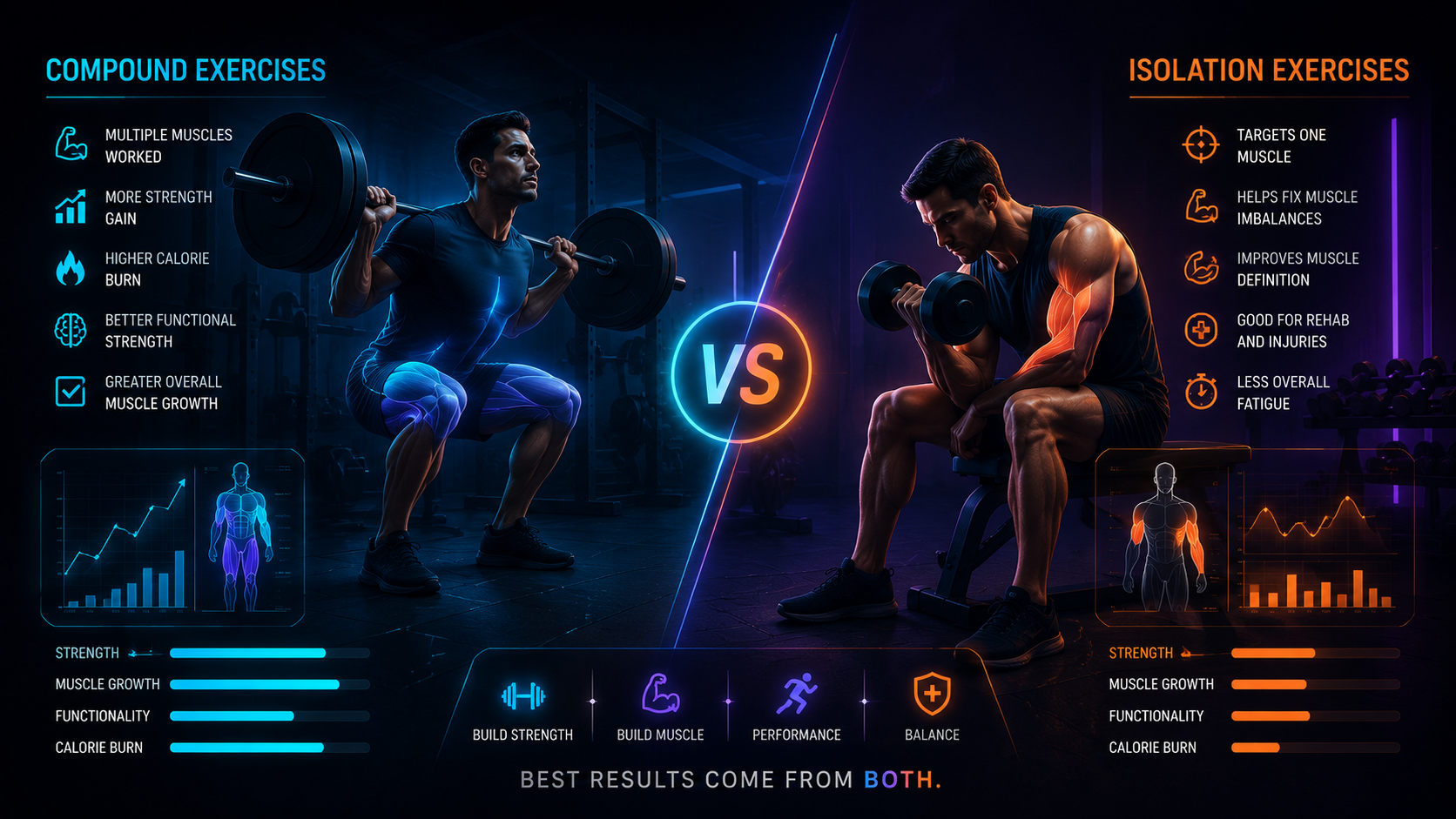
Compound vs Isolation Exercises: Which Builds More Muscle and Strength?

Compound vs Isolation Exercises: Which Builds More Muscle and Strength?

Introduction

When you walk into a gym, you’re faced with a sea of choices: barbells, dumbbells, cables, and machines. But the most fundamental decision you’ll make is whether to prioritize compound exercises (like squats and deadlifts) or isolation exercises (like bicep curls and leg extensions). This debate has raged for decades, but the science offers clear guidance. In this post, we’ll break down the research on compound vs isolation exercises, how they affect muscle growth, strength, and injury risk, and how to combine them for maximum results—all while showing how the DEEP app can help you track and optimize your training.

What Are Compound and Isolation Exercises?

Compound exercises involve multiple joints and muscle groups working together. Examples include:

Isolation exercises target a single joint and primarily one muscle group. Examples include:

The distinction matters because different exercises recruit different amounts of muscle mass and produce different hormonal and neural responses.

Do Compound Exercises Build More Muscle Than Isolation Exercises?

Yes, compound exercises generally stimulate more total muscle growth because they recruit more muscle fibers and produce greater systemic anabolic responses, but isolation exercises are essential for targeting specific weak points and maximizing hypertrophy in individual muscles.

A landmark study by Gentil et al. (2017) compared the effects of compound-only training (squat, bench press, etc.) vs a combination of compound and isolation exercises over 10 weeks. The group that added isolation exercises showed significantly greater increases in biceps and triceps thickness, while both groups gained similar quadriceps size. This suggests that while compounds are efficient, isolation work can enhance growth in specific muscles that may be under-recruited during compounds.

Another study by Schoenfeld et al. (2014) found that when total volume was equated, there was no significant difference in muscle growth between compound and isolation exercises for the quadriceps. However, for smaller muscles like the biceps, isolation exercises produced greater hypertrophy because compounds like pull-ups don’t fully activate the biceps to failure.

Practical takeaway: Use compounds as your foundation (60-80% of your training volume) and add isolation work to target muscles that lag behind or need extra stimulation.

How Do Compound and Isolation Exercises Compare for Strength Gains?

Compound exercises are superior for building overall strength and functional power because they train the nervous system to coordinate multiple muscle groups and move heavier loads.

Strength is highly specific to the movement pattern. A study by Rhea et al. (2003) showed that squat training improved squat 1RM by 25%, but only improved leg press 1RM by 15%. This means that if your goal is to get stronger at a specific compound lift, you must train that lift directly.

However, isolation exercises can contribute to strength gains indirectly. For example, stronger triceps (from tricep pushdowns) can improve your bench press lockout. A meta-analysis by Grgic et al. (2021) found that adding isolation work to a compound-only program improved performance in the compound lift by an additional 5-10% over 8-12 weeks.

Comparison table for strength:

Exercise Type Best For Example Strength Transfer
Compound Maximal strength, power Squat High to similar patterns, low to different
Isolation Weak point correction Leg extension Moderate to compounds involving same muscle

Practical takeaway: If your primary goal is strength, focus 80% of your volume on compounds. Use isolation to bring up weak points (e.g., weak glutes for squats, weak triceps for bench).

Which Exercises Are Better for Injury Prevention and Joint Health?

Compound exercises build resilience by strengthening multiple joints and muscles in a coordinated pattern, but isolation exercises can be safer for rehabbing specific injuries and correcting muscle imbalances.

A systematic review by Lauersen et al. (2014) found that strength training reduced sports injuries by 33%, with compound exercises like squats and deadlifts being particularly effective for preventing lower body injuries. This is because they strengthen the entire kinetic chain, improving stability and coordination.

However, isolation exercises shine in rehabilitation. For example, if you have a knee injury, leg extensions (performed in a pain-free range) can strengthen the quadriceps without stressing the hamstrings or hips. Similarly, rotator cuff isolation exercises are a cornerstone of shoulder rehab.

Practical takeaway: Include compounds for overall resilience, but use isolation exercises to address specific weaknesses or recover from injuries. Always prioritize form over load.

How Should You Program Compound and Isolation Exercises Together?

The most effective approach is to start with compound exercises when you’re fresh, then add isolation exercises for volume and weak point training—a strategy known as ‘compounds first, isolation later.’

Research by Simão et al. (2005) showed that performing compounds before isolation led to greater strength gains in the compounds, while the reverse order didn’t affect isolation gains. This is because compounds require more neural drive and energy, which is highest at the start of your workout.

Here’s a sample weekly split based on this principle:

Day Compound (2-3 exercises) Isolation (2-3 exercises)
Upper A Bench press, Bent-over row, Overhead press Bicep curls, Tricep pushdowns, Lateral raises
Lower A Squat, Romanian deadlift Leg extensions, Leg curls, Calf raises
Upper B Pull-ups, Incline bench, Seated row Face pulls, Hammer curls, Skull crushers
Lower B Deadlift, Front squat Hip thrusts, Bulgarian split squats, Calf raises

Volume recommendations: For compounds, aim for 3-5 sets of 5-10 reps. For isolation, 2-4 sets of 10-20 reps. Use DEEP’s workout builder to log your sets, reps, and weights, and let the AI coach suggest adjustments based on your recovery and sleep data.

Can You Build Muscle with Only Compound Exercises?

Yes, you can build significant muscle with only compound exercises, especially as a beginner, but you’ll eventually hit a plateau in specific muscles that require isolation work for continued growth.

A study by Gentil et al. (2015) found that a program of only compound exercises (squat, bench press, row, overhead press, deadlift) produced substantial hypertrophy in all major muscle groups over 8 weeks in untrained individuals. However, trained individuals showed less growth in the biceps and triceps compared to a group that added isolation work.

This is because compounds don’t always fully fatigue every muscle involved. For example, during pull-ups, your biceps are a synergist, but they may not reach failure before your back does. Isolation exercises allow you to specifically target those muscles to failure, which is a key driver of hypertrophy (Schoenfeld, 2010).

Practical takeaway: Beginners can start with compound-only programs for 3-6 months. After that, add 2-4 isolation exercises per week to target lagging muscles.

What Does the Science Say About Training Frequency for Compounds vs Isolation?

Compound exercises benefit from lower frequency (1-2 times per week) due to higher neural and systemic fatigue, while isolation exercises can be trained more frequently (2-4 times per week) because they cause less overall stress.

A meta-analysis by Ralston et al. (2017) found that for multi-joint exercises like squats, training 2 times per week produced similar strength gains to 3 times per week, but with less fatigue. For isolation exercises, a study by Gentil et al. (2013) showed that training biceps 3 times per week led to greater hypertrophy than 1 time per week, even when total volume was equal.

Practical takeaway: Hit compounds 1-2 times per week with 48-72 hours of recovery between sessions. For isolation, you can train them 2-4 times per week, as long as you manage volume and avoid overtraining.

How Does Sleep and Recovery Affect Compound vs Isolation Training?

Compound exercises place a greater demand on your central nervous system and require more sleep and recovery to avoid overtraining, while isolation exercises are less taxing and can be done even when sleep is suboptimal.

Research by Fullagar et al. (2015) showed that sleep deprivation reduces performance in compound lifts like squats and deadlifts by 10-20%, but has a smaller effect on isolation exercises (5-10%). This is because compounds require more coordination and neural drive, which are impaired by poor sleep.

DEEP’s sleep tracking feature can help you monitor your recovery. If your sleep score is low, consider swapping a heavy compound day for more isolation work or a deload week. The AI coach can adjust your training plan based on your sleep, HRV, and readiness scores.

Practical Guidelines for Combining Both

  1. Prioritize compounds for strength and overall mass. Aim for 2-3 compounds per workout.
  2. Add isolation for weak points, injury prevention, and extra volume. Use 2-4 isolation exercises per workout.
  3. Order matters: Compounds first, then isolation.
  4. Adjust frequency: Compounds 1-2x/week, isolation 2-4x/week.
  5. Listen to your body: If you’re fatigued or sleep-deprived, focus on isolation work.
  6. Track everything: Use DEEP to log your workouts, sleep, and nutrition. The app’s 1,800+ exercise library includes both compound and isolation movements with video demos and form tips.

Conclusion

Compound and isolation exercises are not enemies—they’re partners. Compounds build the foundation of strength and muscle, while isolation exercises fill in the gaps and bring up lagging areas. The science is clear: use compounds for efficiency and overall development, then add isolation for targeted growth and injury prevention. Start your next workout with a heavy compound, finish with precise isolation, and let DEEP’s AI health coach guide your recovery and progression.

Ready to optimize your training? Download DEEP for free on the App Store and unlock 1,800+ exercises, AI-powered workout plans, sleep tracking, and nutrition tools—all in one app.