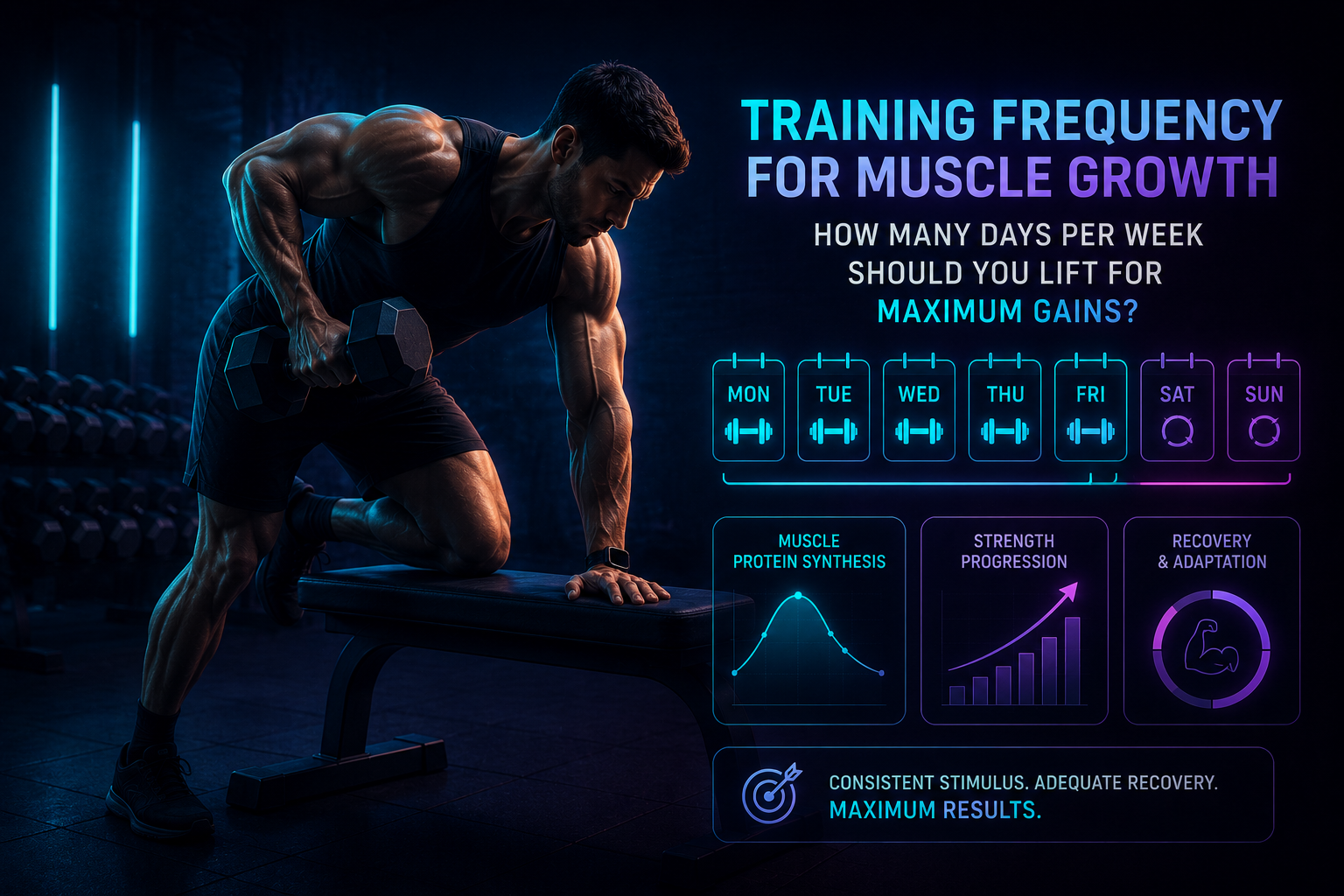
Training Frequency for Muscle Growth: How Many Days Per Week Should You Lift for Maximum Gains?

Training Frequency for Muscle Growth: How Many Days Per Week Should You Lift for Maximum Gains?

When it comes to building muscle, one of the most debated topics in fitness is training frequency: How many days per week should you hit each muscle group to maximize growth? While some swear by hitting every muscle once a week (like a classic bro split), others advocate for hitting each muscle two or even three times weekly. The science, however, offers clear guidance. Let’s break down the research, the practical applications, and how you can leverage this knowledge with tools like DEEP to optimize your results.

What Does the Science Say About Training Frequency for Hypertrophy?

Research consistently shows that training a muscle group two times per week is superior to once per week for muscle growth, especially in natural lifters. A landmark 2016 meta-analysis by Schoenfeld et al. published in the Journal of Sports Sciences examined 10 studies and found that training each muscle group twice per week led to significantly greater hypertrophy compared to once per week. The effect was particularly pronounced in compound movements like the squat and bench press. However, the difference between two and three times per week was minimal, suggesting diminishing returns. For strength, higher frequencies (3+ days per week per muscle) may offer slight advantages due to neural adaptations and skill practice, but for pure size, two sessions per muscle group per week appears to be the sweet spot.

How Does Training Frequency Affect Strength Gains Compared to Muscle Growth?

Strength gains respond well to higher frequencies, often benefiting from 3-4 sessions per muscle group per week, while hypertrophy peaks at 2 sessions per week. A 2018 study in Sports Medicine (also by Schoenfeld and colleagues) analyzed 22 studies and found that for maximal strength (e.g., 1RM squat), frequencies of 3+ times per week produced slightly better results than 2 times per week. This is because strength is heavily neural—practicing a movement more often improves coordination and motor unit recruitment. For hypertrophy, the total weekly volume (sets per muscle) matters more than frequency, as long as you hit each muscle at least twice. So, if your goal is pure strength, you can train more often (e.g., a squat every day or every other day). For muscle size, two quality sessions per week per muscle group is ideal.

What Is the Optimal Weekly Training Split Based on Frequency?

The best split depends on your schedule, recovery capacity, and goals, but an upper-lower split (4 days/week) or a push-pull-legs (PPL) split (6 days/week) can both hit optimal frequencies. Let’s compare common splits in the table below:

Split Type Days/Week Frequency per Muscle Group Best For Recovery Demand
Full Body 3 3x/week Beginners, time-efficient Low to Moderate
Upper-Lower 4 2x/week Intermediate, balanced growth Moderate
Push-Pull-Legs (PPL) 6 2x/week (each muscle) Advanced, high volume High
Bro Split (e.g., chest/triceps) 5-6 1x/week Advanced, specialized focus Low per session, high overall

For most people, an upper-lower split (e.g., Monday: Upper, Tuesday: Lower, Thursday: Upper, Friday: Lower) provides the ideal balance of frequency and recovery. PPL is great if you can commit to 6 days and manage fatigue. Full body three times a week is excellent for beginners or those with limited time.

Can You Train the Same Muscle Group Every Day for Faster Gains?

Training the same muscle daily is not recommended for most people because muscles need 48-72 hours to recover and grow, and daily training increases injury risk without added benefit. While some elite powerlifters train squats daily (very low volume, high intensity), this is not applicable for hypertrophy. A 2017 study in PeerJ found that training biceps three times per week produced similar growth to training them once per week when total volume was equalized, but daily training (7x/week) led to overtraining markers and no additional gains. Muscle protein synthesis (MPS) peaks around 24-48 hours post-exercise and returns to baseline by 72 hours. Training a muscle before it has recovered blunts the anabolic response. Stick to 2-3 sessions per muscle per week for optimal results.

How Many Sets Per Muscle Group Per Week Should You Do for Maximum Hypertrophy?

The optimal weekly volume for hypertrophy is 10-20 sets per muscle group per week, spread across 2-3 sessions, according to current research. A 2019 systematic review in Medicine & Science in Sports & Exercise by Schoenfeld et al. found a dose-response relationship up to about 15-20 sets per muscle per week, after which gains plateau. For example, if you’re doing 12 sets for chest per week, you could split that into 6 sets on Monday and 6 on Thursday. Going beyond 20 sets may lead to diminishing returns and increased injury risk. Beginners can start with 10-12 sets per muscle per week and progress gradually. DEEP’s workout builder can help you track sets and volume per muscle group automatically, ensuring you stay in the optimal range without guesswork.

Does Training Frequency Impact Recovery and Injury Risk?

Higher training frequency can improve recovery by distributing volume across more sessions, but only if total volume is controlled—otherwise, it increases injury risk. A 2021 study in the Journal of Strength and Conditioning Research compared high-frequency (6 days/week) vs. low-frequency (3 days/week) with equal total volume. The high-frequency group reported lower perceived fatigue and better recovery scores, likely because each session was less taxing. However, when volume was increased (e.g., 20+ sets per session), injury rates climbed. The key is to keep per-session volume moderate (e.g., 8-12 sets per workout) and prioritize sleep and nutrition. DEEP’s sleep tracking can monitor your recovery by measuring HRV and sleep quality, alerting you if you’re under-recovered and need to adjust frequency or volume.

How Should Beginners vs. Advanced Lifters Adjust Training Frequency?

Beginners benefit most from full-body workouts three times per week, while advanced lifters may need higher frequency (4-6 days) to accumulate sufficient volume per muscle group. Beginners can stimulate growth with lower volume because they are more sensitive to training stimuli. A 2018 study in Frontiers in Physiology showed that untrained individuals gained similar muscle from 3 sets per muscle per week as from 6 sets. As you become more advanced, your muscles become more resistant to growth, requiring more volume and thus more frequent sessions to spread that volume. For example, an advanced lifter needing 18 sets for quads might split that into 6 sets on Monday, 6 on Wednesday, and 6 on Friday. DEEP’s AI health coach can suggest frequency adjustments based on your training history and recovery data.

What Role Does Sleep Play in Optimizing Training Frequency?

Sleep is the foundation of recovery; without adequate sleep (7-9 hours), even the best training frequency will fail to produce gains. A 2020 study in Sleep found that sleep deprivation reduced muscle protein synthesis by 18% and increased cortisol, a catabolic hormone. If you train with high frequency but sleep poorly, you risk overtraining and injury. DEEP’s sleep tracking provides detailed sleep stage analysis (deep, light, REM) and a Sleep Score, helping you ensure you’re recovering enough to handle your training frequency. For instance, if your Sleep Score drops below 70, consider reducing frequency or volume for a few days.

How Can DEEP Help You Optimize Your Training Frequency?

DEEP integrates your sleep, nutrition, and training data to recommend the perfect frequency and volume for your body. Instead of guessing, you can use DEEP to log your workouts (with 1,800+ exercises), track your sleep HRV and duration, and log your meals (800K+ foods, barcode scanner). The AI health coach analyzes your recovery and training load, suggesting when to increase frequency (e.g., if you’re recovering well) or decrease it (e.g., if HRV is low). For example, if you’ve been doing PPL six days a week but your HRV is declining and sleep quality is poor, DEEP might recommend switching to an upper-lower four-day split until recovery improves.

Final Takeaway: What’s the Best Training Frequency for You?

The best training frequency is one that allows you to hit each muscle group 2 times per week with 10-20 weekly sets, while prioritizing sleep and nutrition. Start with an upper-lower split (4 days) or full body (3 days) if you’re a beginner. Track your progress and recovery. If you stall, adjust frequency or volume. Remember, consistency over months matters more than perfection in a single week.

Ready to build your perfect training plan? Download DEEP for free on the App Store and let our AI health coach guide your frequency, volume, and recovery—so you can train smarter, not harder.