DEEP
Features Guides Blog Compare

Upper-Lower vs. PPL vs. Full Body: Which Workout Split is Best for Your Goals?

April 19, 2026 · DEEP Team · 6 min read

Upper-Lower vs. PPL vs. Full Body: Which Workout Split is Best for Your Goals?

Navigating the world of workout programming can feel like deciphering a secret code. PPL, Upper-Lower, Full Body—each promises optimal results, but which one truly aligns with your goals, recovery capacity, and lifestyle? Choosing the right split isn't about finding the "best" one universally, but the best one for you. This guide breaks down the science, pros, cons, and ideal candidates for the three most popular training splits to help you build a more effective, sustainable routine.

What Are the Core Differences Between an Upper-Lower, PPL, and Full Body Split?

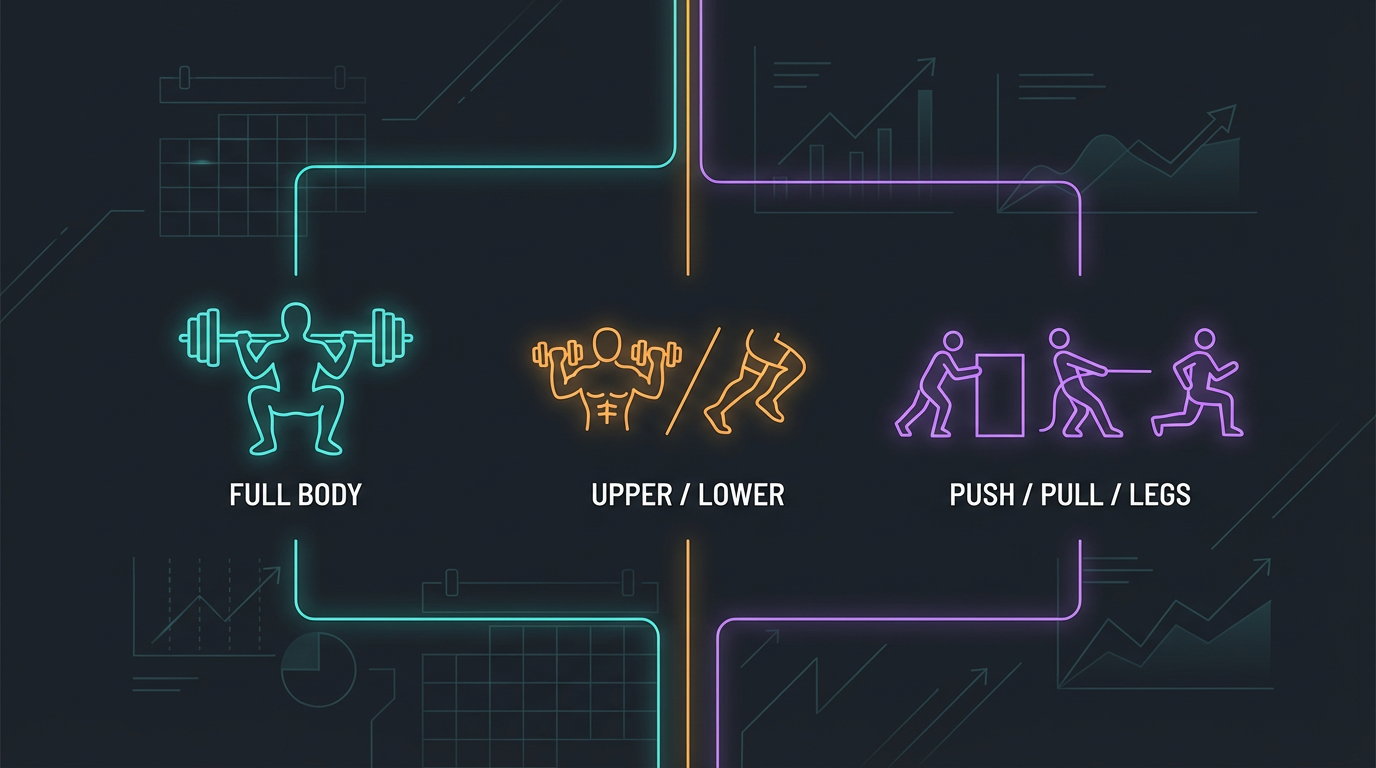
The core difference lies in training frequency and specialization: Full Body trains all major muscle groups 2-3 times per week, Upper-Lower divides sessions into upper and lower body focus (4 days/week), and PPL (Push, Pull, Legs) isolates movement patterns into three distinct days, allowing for higher volume per muscle group per session (typically 6 days/week).

Think of these splits on a spectrum from frequency to specialization. Full Body prioritizes high frequency with moderate volume per session. Upper-Lower offers a middle ground, balancing frequency with slightly more focused volume. PPL leans into high volume and specialization per session, often at the cost of lower frequency for each muscle group.

Split Type Weekly Sessions Muscle Frequency Volume Per Session Primary Focus
Full Body 2-3 High (2-3x/week) Low-Moderate Frequency, Practice, Efficiency
Upper-Lower 4 Moderate-High (2x/week) Moderate Balance, Strength, Hypertrophy
Push/Pull/Legs 3-6 Moderate (1-2x/week) High Specialization, Volume, Detail

Who Should Use a Full Body Workout Split?

A Full Body split is ideal for beginners, individuals with limited time (2-3 days/week), those focusing on strength foundations, or anyone returning from a long layoff.

The primary advantage of Full Body training is neuromuscular efficiency. By practicing compound movements like squats, presses, and rows multiple times per week, you reinforce motor patterns more quickly, leading to faster initial strength gains. Research supports higher frequencies for strength development, especially in novice lifters. A 2018 meta-analysis in Sports Medicine concluded that training each muscle group at least twice per week promotes superior hypertrophic outcomes compared to once-weekly training. Full Body is the most straightforward way to achieve this.

Practical Implementation:

  • Structure: Each session includes 1-2 compound lifts for lower body (e.g., squat, deadlift variant), 1-2 for upper body push (e.g., bench press, overhead press), and 1-2 for upper body pull (e.g., row, pull-up).
  • Volume Management: Keep total hard sets per muscle group per session around 2-4 to avoid excessive fatigue.
  • Progression: Since you're performing key lifts frequently, you can add small increments of weight or reps each week. The DEEP app's workout builder is perfect for creating and tracking these efficient, multi-compound sessions, ensuring you log your progress across all movements.

When Does an Upper-Lower Split Make the Most Sense?

An Upper-Lower split is the versatile "goldilocks" option for intermediate lifters, those seeking a balanced approach to muscle and strength, or athletes requiring 4 training days per week.

This split increases the training volume per muscle group per session compared to Full Body, while still maintaining a twice-weekly frequency. This balance is often cited as optimal for continued hypertrophy. A study published in the Journal of Strength and Conditioning Research found that a twice-weekly frequency per muscle group was effective for maximizing muscle protein synthesis rates over a training week.

Practical Implementation:

  • Structure:
    • Lower Day: Focus on quad-dominant (squats) and hip-dominant (deadlifts, glute bridges) movements, plus calf and core work.
    • Upper Day: Balance horizontal push/pull (bench press & rows) with vertical push/pull (overhead press & pull-ups).
  • Variants: You can run a 4-day straight split (Upper, Lower, Rest, Upper, Lower) or an alternating split with a rest day after every two sessions.
  • Advantage: It allows for more accessory work and isolation exercises than Full Body, addressing weak points while maintaining frequency. Using DEEP's exercise library of 1,800+ movements, you can easily build varied Upper and Lower days, swapping exercises to prevent monotony while tracking your progressive overload on main lifts.

Is a Push, Pull, Legs (PPL) Split Only for Advanced Lifters?

No, a PPL split can be run by anyone, but its typical 6-day format demands high recovery capacity, time commitment, and is most effective for those with a solid base seeking maximum volume for hypertrophy.

PPL excels at allowing you to fully fatigue a specific movement pattern in one session. On a Push day, for example, you can perform chest, shoulder, and tricep exercises without being pre-fatigued by back work. This can lead to greater total volume per muscle group per week, a key driver of muscle growth. However, each muscle group is typically trained only once every 5-7 days in a 6-day cycle, which is on the lower end of the recommended frequency spectrum. The success of PPL hinges on achieving sufficient weekly volume in that one session.

Practical Implementation:

  • Structure:
    • Push: Chest, Shoulders, Triceps.
    • Pull: Back, Rear Delts, Biceps.
    • Legs: Quads, Hamstrings, Glutes, Calves.
  • Frequency: Run as PPLPPLR (6 days on, 1 rest) or PPLRPPL (3 on, 1 rest, 3 on).
  • Volume Warning: It's easy to overdo it. A 2017 systematic review in Medicine & Science in Sports & Exercise suggested that most individuals see diminishing returns on hypertrophy beyond 10-20 hard sets per muscle group per week. On a 6-day PPL, you might aim for 5-10 hard sets per muscle group per session.
  • Best For: Individuals with strong recovery (influenced by sleep, nutrition, and stress), those with specific body part specialization goals, and lifters who prefer longer, more focused gym sessions.

How Do I Choose Based on My Schedule and Recovery Ability?

Match the split to your available training days: 2-3 days = Full Body, 4 days = Upper-Lower, 5-6 days = PPL or Upper-Lower variant. Then, adjust volume based on your recovery metrics.

Your schedule is the first filter. The second, and more critical, filter is recovery. A 6-day PPL split is a recipe for burnout if you're sleeping 6 hours a night, under high stress, and not eating adequately. Recovery is multi-faceted:

  • Sleep: The non-negotiable foundation. Poor sleep sabotages muscle repair, hormone regulation, and neural recovery.
  • Nutrition: Sufficient protein and calories to support repair and energy.
  • Life Stress: High cognitive load and stress impair physiological recovery.

Actionable Decision Tree:

  1. Count your available, dedicated training days per week.
  2. Audit your recovery: Use DEEP's sleep and HRV tracking to gauge your baseline. Consistently low HRV scores or poor sleep efficiency are red flags to opt for a less frequent split.
  3. Start conservative: It's always better to start with less volume (e.g., a 3-day Full Body) and add a day or session if you're recovering well, than to start overwhelmed and get injured or quit.
  4. Be flexible: Your ideal split can change with life phases. A busy work project might necessitate a shift from PPL to Upper-Lower for a month.

Can I Combine or Rotate Different Splits for Better Results?

Yes, periodizing your training split throughout the year—a concept called "block periodization"—can prevent plateaus, manage fatigue, and boost long-term progress.

Sticking rigidly to one split forever can lead to adaptation staleness and overuse injuries. Intelligent rotation follows the general adaptation syndrome: apply a stress, adapt to it, then change the stress.

Sample Annual Plan:

  • Block 1 (2-3 months, General Prep): Full Body 3x/week. Focus on movement mastery and building work capacity.
  • Block 2 (2-3 months, Hypertrophy): Upper-Lower 4x/week. Increase volume to stimulate muscle growth.
  • Block 3 (1-2 months, Strength): Return to Full Body 3x/week or an Upper-Lower, but with heavier loads, lower reps, and more rest between sets.
  • Block 4 (Active Deload): Reduce volume by 40-50% or take a full week off to supercompensate.

You can then cycle back, perhaps starting the next hypertrophy block with a 5-day PPL split for a new stimulus. The DEEP app's AI Coach can help you navigate these transitions by suggesting deload weeks based on your performance trends and recovery data, ensuring you're not blindly following a calendar but responding to your body's signals.

Ultimately, the "best" split is the one you can perform consistently, recover from adequately, and progressively overload over months and years. It should fit your life, not the other way around. Experiment, track your performance and recovery metrics closely, and don't be afraid to switch gears when progress stalls or life demands change.

Ready to build your ideal workout split with precision? Download DEEP for free on the App Store. Access our full exercise library, AI-powered workout builder, and integrated recovery tracking to create a training plan that truly fits your goals and lifestyle.

Features Guides Blog Compare FAQ
Privacy Policy Terms of Service Contact

© 2026 DEEP. All rights reserved.