The Ultimate Guide to TDEE and Metabolism: How to Calculate Your Calorie Needs for Fat Loss and Muscle Gain
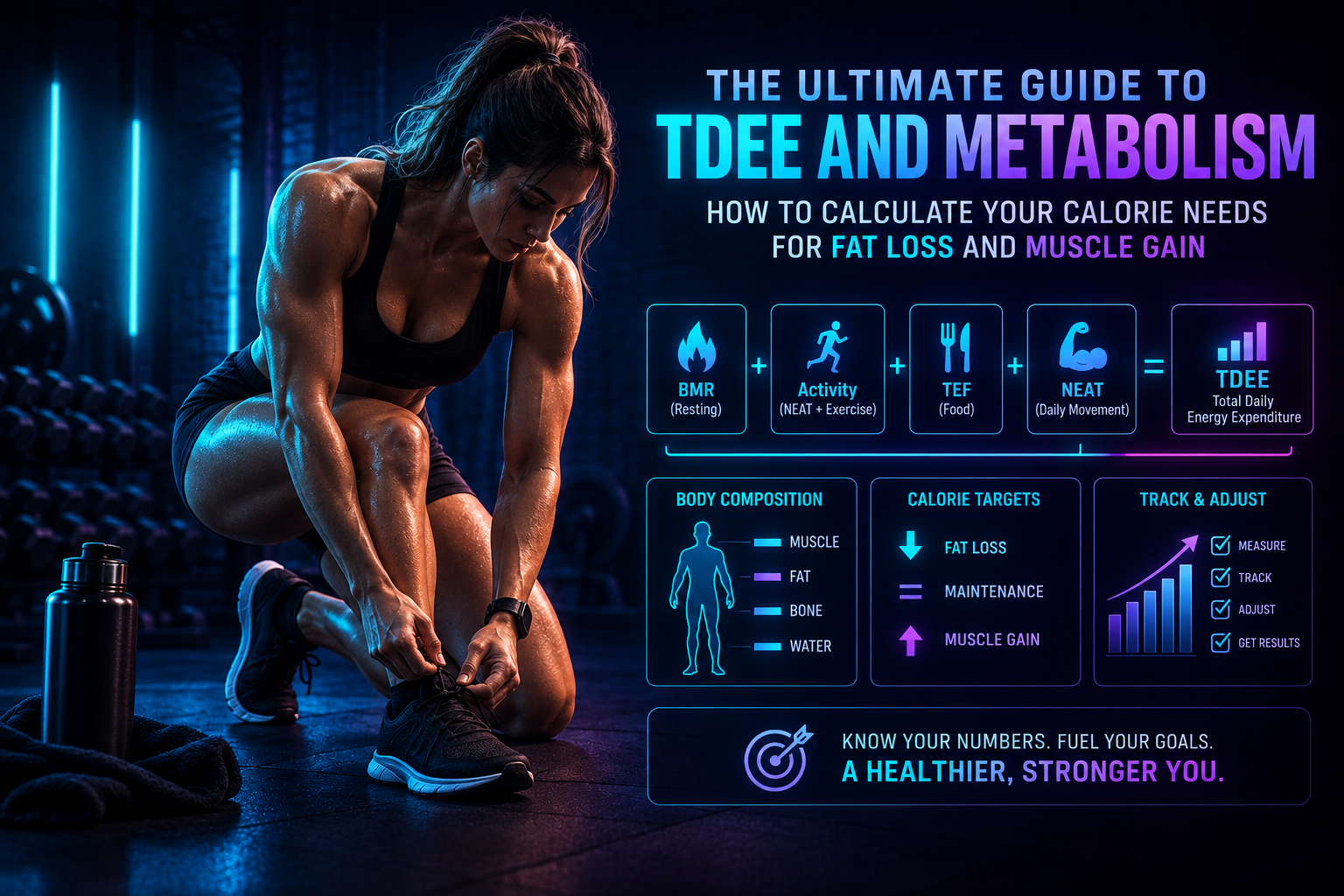
The Ultimate Guide to TDEE and Metabolism: How to Calculate Your Calorie Needs for Fat Loss and Muscle Gain
If you’ve ever wondered why your friend can eat pizza and stay lean while you gain weight from a salad, you’ve stumbled into the complex world of metabolism and Total Daily Energy Expenditure (TDEE). Understanding your TDEE is the single most important factor in designing a nutrition plan that works for your body—whether your goal is fat loss, muscle gain, or maintenance. In this guide, we’ll break down the science of metabolism, show you exactly how to calculate your calorie needs, and give you actionable strategies to adjust your intake for optimal results.
What Is TDEE and Why Is It More Accurate Than Basal Metabolic Rate?
Total Daily Energy Expenditure (TDEE) is the total number of calories your body burns in a 24-hour period, including all activities, digestion, and basic life-sustaining functions. While Basal Metabolic Rate (BMR) only accounts for the calories needed at complete rest (think: lying in bed all day), TDEE gives you a real-world number based on your activity level.
A landmark study published in Science (2018) by Pontzer et al. found that total energy expenditure in humans is remarkably predictable when accounting for body size and physical activity, but individual variations can be as high as 600 calories per day between two people of the same weight and height. This is why generic diet plans often fail—they don’t account for your unique TDEE.
How TDEE Breaks Down
| Component | Description | Approximate % of TDEE |
|---|---|---|
| Basal Metabolic Rate (BMR) | Calories burned at rest for breathing, circulation, cell production | 60-75% |
| Thermic Effect of Food (TEF) | Calories burned digesting and absorbing nutrients | 10-15% |
| Non-Exercise Activity Thermogenesis (NEAT) | Calories burned through daily movement like walking, fidgeting, standing | 15-30% |
| Exercise Activity Thermogenesis (EAT) | Calories burned during intentional exercise | 5-10% |
Research from the American Journal of Clinical Nutrition (2019) shows that NEAT is the most variable component, ranging from 100 to 800 calories per day depending on your lifestyle. This is why two people with the same BMR can have vastly different TDEEs.
How Do You Calculate Your TDEE Accurately?
The most accurate way to calculate your TDEE is to use the Mifflin-St Jeor equation to find your BMR, then multiply by an activity factor that matches your lifestyle. This formula has been validated by the Journal of the Academy of Nutrition and Dietetics (2015) as the most reliable for the general population.
Mifflin-St Jeor Equation
- For men: BMR = (10 × weight in kg) + (6.25 × height in cm) – (5 × age in years) + 5
- For women: BMR = (10 × weight in kg) + (6.25 × height in cm) – (5 × age in years) – 161
Activity Multipliers
| Activity Level | Description | Multiplier |
|---|---|---|
| Sedentary | Little or no exercise, desk job | 1.2 |
| Lightly active | Light exercise 1-3 days/week | 1.375 |
| Moderately active | Moderate exercise 3-5 days/week | 1.55 |
| Very active | Hard exercise 6-7 days/week | 1.725 |
| Extra active | Very hard exercise, physical job, training twice daily | 1.9 |
Example: A 30-year-old woman weighing 70 kg (154 lbs) and 170 cm (5’7") who exercises 4 days per week:
- BMR = (10 × 70) + (6.25 × 170) – (5 × 30) – 161 = 700 + 1062.5 – 150 – 161 = 1451.5 calories
- TDEE = 1451.5 × 1.55 = 2250 calories
For even greater precision, you can track your actual calorie intake and weight changes over 2-3 weeks using a tool like DEEP’s nutrition tracker, which logs your meals and adjusts your TDEE based on real-world data. The app’s AI coach can also calculate your TDEE automatically when you input your stats.
What Factors Actually Influence Your Metabolism?
Your metabolic rate is influenced by six key factors: muscle mass, age, sex, genetics, hormonal status, and dietary habits. While you can’t change your genetics or age, you can manipulate several of these to boost your metabolism.
Muscle Mass and Metabolism
A meta-analysis in Obesity Reviews (2020) found that each kilogram of muscle burns approximately 13 calories per day at rest, compared to 4.5 calories per kilogram of fat. This means that adding 5 kg of muscle can increase your BMR by about 65 calories daily—small but meaningful over time.
Age-Related Metabolic Decline
Research from Science (2021) using data from over 6,400 participants showed that metabolism remains stable from age 20 to 60, then declines by about 0.7% per year after age 60. The common belief that metabolism crashes in your 30s is a myth—most age-related decline is due to muscle loss, not aging itself.
Hormonal Influences
- Thyroid hormones: Hypothyroidism can reduce BMR by 15-30%
- Cortisol: Chronic stress elevates cortisol, which can increase appetite and reduce metabolic efficiency
- Sex hormones: Testosterone supports muscle mass; estrogen fluctuations during menopause can reduce BMR by 10-15%
Dietary Thermogenesis
Protein has the highest thermic effect of food (TEF) at 20-30%, compared to 5-10% for carbs and 0-3% for fat. A study in the Journal of Nutrition (2018) found that a high-protein diet (30% of calories) increased 24-hour energy expenditure by 80-100 calories compared to a low-protein diet (15% of calories).
How Should You Adjust Calories for Fat Loss or Muscle Gain?
For fat loss, create a deficit of 300-500 calories below your TDEE; for muscle gain, add 200-400 calories above your TDEE. These ranges minimize muscle loss during cutting and fat gain during bulking, based on research in the Journal of the International Society of Sports Nutrition (2019).
Fat Loss Guidelines
| Deficit Level | Calories Below TDEE | Expected Weekly Loss |
|---|---|---|
| Moderate | 300-400 | 0.5-0.8 lbs (0.2-0.4 kg) |
| Aggressive | 500-600 | 1-1.2 lbs (0.5-0.6 kg) |
| Extreme (not recommended) | 800+ | 1.5+ lbs (0.7+ kg), high muscle loss risk |
Muscle Gain Guidelines
| Surplus Level | Calories Above TDEE | Expected Weekly Gain |
|---|---|---|
| Lean bulking | 200-300 | 0.25-0.5 lbs (0.1-0.2 kg) |
| Moderate bulking | 300-400 | 0.5-0.8 lbs (0.2-0.4 kg) |
| Dirty bulking (not recommended) | 500+ | 1+ lbs (0.5+ kg), mostly fat |
A systematic review in Sports Medicine (2020) concluded that a 300-500 calorie deficit is optimal for preserving lean mass while losing fat, provided protein intake is adequate (1.6-2.2 g per kg of body weight).
Can You Boost Your Metabolism Naturally?
Yes, you can increase your metabolic rate by up to 15% through strategic nutrition, exercise, and lifestyle changes. Here are five evidence-based strategies:
1. Build Muscle Through Resistance Training
Resistance training increases BMR by 5-10% over 10 weeks, according to a study in Medicine & Science in Sports & Exercise (2018). This is because muscle tissue is metabolically active and requires more energy to maintain.
2. Eat Enough Protein
Aim for 1.6-2.2 g of protein per kg of body weight. The TEF of protein alone can add 80-100 calories to your daily expenditure, as shown in the Journal of Nutrition study mentioned earlier.
3. Stay Hydrated
Even mild dehydration can reduce metabolic rate by 2-3%, per research in the Journal of Clinical Endocrinology & Metabolism (2016). Drinking 500 ml of water can temporarily increase metabolism by 24-30% for about an hour.
4. Incorporate High-Intensity Interval Training (HIIT)
HIIT creates an afterburn effect (excess post-exercise oxygen consumption, or EPOC) that can elevate metabolism for up to 24 hours post-workout. A study in the Journal of Strength and Conditioning Research (2017) found that HIIT increased 24-hour energy expenditure by 6-15% compared to steady-state cardio.
5. Get Adequate Sleep
Sleep deprivation reduces BMR by 5-8% and increases ghrelin (hunger hormone) by 14-20%, according to a study in the American Journal of Clinical Nutrition (2019). Prioritizing 7-9 hours of quality sleep is a metabolic non-negotiable.
With DEEP’s sleep tracking feature, you can monitor your sleep quality and see how it correlates with your energy levels and weight trends, helping you optimize all three pillars of health simultaneously.
How Do You Track Progress Without Obsessing Over the Scale?
The most accurate way to track progress is to combine weekly weight measurements with body measurements, progress photos, and how your clothes fit. The scale alone can be misleading due to water weight fluctuations of 2-5 lbs (1-2.5 kg) daily.
Weekly Tracking Protocol
- Weigh yourself every morning after using the bathroom, before eating or drinking
- Take waist, hip, and thigh measurements every two weeks
- Take progress photos in consistent lighting every 4 weeks
- Log your food intake daily using a tool like DEEP’s barcode scanner or AI label scanner to ensure accuracy
A study in the International Journal of Behavioral Nutrition and Physical Activity (2020) found that people who tracked their food intake at least 3-4 days per week were 2.5 times more likely to achieve their weight goals than those who didn’t track at all.
Should You Adjust Your TDEE as You Lose Weight or Gain Muscle?
Yes, you need to recalculate your TDEE every 5-10 lbs (2-5 kg) of body weight change, as your energy needs decrease with weight loss and increase with muscle gain. This is often called “metabolic adaptation.”
Research in Obesity (2016) showed that after losing 10% of body weight, resting metabolic rate decreases by about 15-20% more than what’s predicted by the weight loss alone—this is metabolic adaptation. To counteract this, you may need to:
- Reduce calories by an additional 50-100 per day after every 10 lbs lost
- Increase NEAT by adding steps (aim for 8,000-10,000 steps daily)
- Recalculate your macros every 4-6 weeks
Conclusion: Your Personalized Metabolism Playbook
Understanding your TDEE and metabolism isn’t about rigid calculations—it’s about giving you the power to make informed decisions. Start by calculating your TDEE, set a modest deficit or surplus, and adjust based on real-world results. Remember that consistency beats perfection: tracking 80% of your meals accurately will yield better results than obsessing over every calorie.
Ready to take the guesswork out of your nutrition? Download DEEP for free on the App Store. With its 800,000+ food database, barcode scanner, AI label scanner, and personalized AI health coach, DEEP helps you calculate your TDEE, track your macros, and adjust your plan in real-time. Plus, you can sync your sleep and workout data to see how your metabolism responds to every variable. Start your journey to a smarter, science-backed approach to health today.